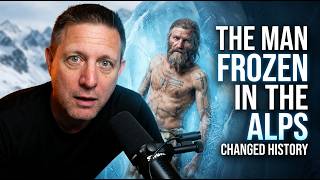
A Crime Scene Frozen in Time
We think of crime scenes as modern things — processed, photographed, mapped out by investigators within hours. But what if a crime scene had been sealed by nature itself, frozen in place for more than five millennia? That's exactly what was waiting in a shallow depression in the ice high in the Ötztal Alps, on what is now the border between Austria and Italy.
His name is Ötzi. And his story may be the oldest murder mystery in human history.
The pass where he was found — Tisenjoch — sits more than 10,000 feet above sea level. It is not a casual route. The terrain is jagged rock, thin air, and sudden storms that can sweep across the peaks without warning. Yet someone was up there. And thanks to the same ice that killed him, we know more about that someone than almost any other person from his era.
Who Was He
Ötzi was approximately 45 years old when he died. In the context of his time, that meant something. When the United States was founded in 1776 — more than three thousand years after Ötzi's death — the average life expectancy was around 35 to 40 years. Ötzi had no hospitals, no antibiotics, no modern medicine of any kind, and yet he had already outlived most people of his era by a decade. He was not fragile. He knew how to survive in a hard world.
He was also not unprepared. The objects found near his body told a clear story of a man who had spent his life in the mountains. He carried a copper axe — rare and valuable for the time — a longbow made from yew wood, a quiver holding arrows, a small flint knife, and carefully stitched clothing made from animal hides. This was not a man who wandered into the mountains by accident. He belonged there.
The Discovery — September 19, 1991
That summer had been unusually warm. Glaciers that normally stayed frozen year-round had begun to melt. On September 19th, two German hikers — Helmut and Erika Simon — were descending through the Alps after crossing the mountain ridge when Helmut noticed something dark in the ice ahead of them.
At first it looked like debris. Then they got closer.
The couple assumed they had found the remains of a recent mountaineering accident — a tragic but not uncommon occurrence in the Alps, where climbers sometimes vanish in storms and reappear years later when glaciers shift. They took photographs and reported the location after returning from the mountain. What they did not know was that the man they had just found had been lying there longer than most of recorded history.
Recovery teams arrived expecting a routine alpine retrieval. They brought pneumatic drills. The body was frozen solid inside the glacier. Storms forced the team to stop and return multiple times over several days. But eventually the body came free — and with it, the objects scattered nearby. That was when everything changed. Investigators realized they were not looking at a modern accident. They were looking at a man from deep history.
The Tattoos
As scientists began studying the body, one detail stood out immediately: Ötzi had tattoos. Not one or two — more than 60 individual marks identified across his body. Most were simple shapes: short lines, crosses, small groupings. They appeared on his lower back, his knees, his ankles, and along his spine.
The initial assumption was that they were decorative. Then doctors compared the tattoo locations against medical scans of his skeleton — and something unexpected appeared. Nearly every tattoo sat directly over a joint where Ötzi had suffered damage or arthritis. The marks weren't decorative. They may have been therapeutic — a form of ancient pain management, something strikingly similar in concept to acupuncture, practiced thousands of years before it was formally documented anywhere in the world.
It was a remarkable finding on its own. But it was not the most important one.
The Arrow in His Shoulder
For more than a decade after the discovery, scientists believed Ötzi had died from exposure. The logic was straightforward: he was alone, high in the mountains, far from any village. A sudden storm. A fall. Exhaustion. It seemed to fit.
Then a medical scan revealed something no one had noticed for over ten years. Deep inside Ötzi's left shoulder, doctors discovered a stone arrowhead. It had entered from behind, and it had sliced through a major artery.
Ötzi had not collapsed in the mountains. He had been shot in the back.
The Final Hours
With that single discovery, researchers went back through everything they knew and began looking at it differently. Ötzi had cuts on his hands — the kind of wounds that suggest he had been fighting, grabbing at a blade. His quiver held arrows that were unfinished, which suggests he may not have been fully prepared for a confrontation when it found him. And the location itself raised its own question: why was a man traveling through one of the most difficult, exposed passes in the Alps in the first place?
Was he fleeing? Was he in pursuit? Was he ambushed by someone who followed him up into the thin air, knowing the mountains would do the rest of the work?
Somewhere behind Ötzi, at more than 10,000 feet above sea level, a bow was drawn. The arrow struck. He collapsed. And the mountain closed over him.
We may never know exactly what happened that day. But five thousand years later, the ice gave back every clue it had been keeping. We are still trying to solve it.