Why Were They Even Out There
Before you can understand what happened on that mountain, you have to understand why nine people were camping in the Ural Mountains in the middle of a Russian winter in the first place. Because on the surface, it sounds insane.
The hikers were students and graduates of the Ural Polytechnic Institute in the Soviet Union. At that time, the Soviet Union maintained a structured outdoor program — a combination of mountaineering, survival training, and long-distance trekking where participants earned certifications by completing expeditions in progressively more demanding conditions. The extreme weather wasn't an unfortunate circumstance. It was the entire point.
The trip they had planned was classified as a Category Three expedition — one of the most difficult levels — requiring travel through remote terrain in harsh winter conditions. The group was led by Igor Dyatlov, a 23-year-old engineering student. Most of the others had already completed difficult winter expeditions before. They traveled on skis, carried heavy packs, and documented everything with cameras and journals.
Originally there were ten hikers. Early in the expedition, one member became ill and turned back. His name was Yuri Yudin. That decision saved his life.
February 1, 1959
Despite the name, Kholat Syakhl was not considered especially dangerous. Remote, yes — in January and February, temperatures there typically dropped below minus 30°C. But experienced hikers had crossed it before. On February 1st, the group reached the slope. Weather conditions had worsened. There was strong wind, blowing snow, and poor visibility. Instead of descending into the forest below to shelter, the hikers chose to camp directly on the mountain slope and push through in the morning.
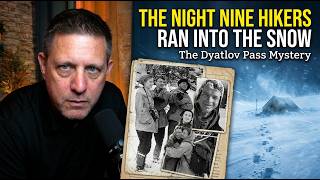
The photos taken that day show nothing unusual. The group was laughing, working together, setting up camp the way they had done on many expeditions before. If you didn't know what was coming, it would look like any other winter trip.
The Tent
The entire group shared one tent — standard practice for Soviet winter expeditions. A single large tent weighed less than multiple smaller ones, and nine bodies sleeping side by side generated enough combined warmth to make a difference in those temperatures. The tent was roughly fourteen feet long. Nine sleeping spaces laid out shoulder to shoulder. Boots near the entrance. Gear stacked along the sides. Nine experienced hikers packed tightly into a narrow canvas shelter on the side of a frozen mountain.
Something happened inside that tent that caused all nine of them to leave it at the same time, in the dark, in the cold, without their boots.
The Search
When the hikers failed to return on schedule, search parties were organized — students, volunteers, and eventually the Soviet military. After several days of searching, rescuers spotted something on the slope: a partially buried tent. They knew immediately that something was wrong.
The tent had collapsed under the snow. But when investigators looked more closely, they found something that changed everything. The fabric had been cut open — not at the entrance, not from the outside. The cuts ran along the side of the tent near where the hikers had been sleeping, and they had been made from the inside outward. Someone inside that tent had grabbed a knife and sliced through the canvas wall to get out.
Outside, nine sets of footprints led downhill toward a forest nearly a mile away. Most of the prints showed hikers wearing only socks. Some were barefoot.
The Bodies
Nearly a mile from the tent, beneath a large pine tree, rescuers found the first two hikers. They had attempted to build a fire. Broken branches high in the tree suggested someone had climbed it — likely trying to see the campsite above. Both had died from hypothermia. They had made it through the night.
Over the following days, three more bodies were found between the tree and the tent. Their positions suggested they had been trying to make their way back to the shelter but never reached it.
The final four were not found until the snow began melting months later. They were discovered in a ravine. And their discovery added a layer of detail that made the case even harder to explain — some clothing tested positive for elevated levels of radiation. That detail has never been fully accounted for.
The Soviet investigation eventually closed the case with a conclusion that satisfied almost no one: the hikers had died due to a compelling natural force.
The 2020 Reinvestigation
Russian investigators reopened the Dyatlov Pass case in 2020, applying modern scientific analysis to the original evidence — studying the terrain, the weather records, the hikers' own journals, and the physical findings from the scene. Their conclusion pointed to something called a slab avalanche.
Unlike the massive wall-of-snow avalanches familiar from films, a slab avalanche occurs when a single layer of compacted snow suddenly breaks loose and slides downhill. It can be smaller in scale but still powerful enough to collapse a tent and injure the people inside. The theory holds that a slab avalanche struck the tent while the hikers were sleeping. They cut their way out quickly, fearing a larger avalanche was coming. Disoriented in the dark, in extreme cold, with no time to dress, the group moved downhill toward the forest. In the darkness and the temperature, they became separated. One by one, they died.
Many researchers accept this explanation as the most consistent with the evidence. Others point to the details it still doesn't fully account for — the radiation on the clothing, the specific injuries found on some of the bodies, the questions around why experienced hikers chose to camp on an exposed slope rather than in the forest below.
Nine hikers. One mountain. A mystery that has inspired books, documentaries, films, and sixty-plus years of debate. The uncertainty is exactly why it endures — because even the best available explanation leaves something unexplained on those frozen slopes.